Finding a home should align with one’s lifestyle and needs. Cribs helps users uncover the complexities in Conveniences through AI.
Introduction
Finding a property that aligns with one’s lifestyle and needs can be a challenging process. With numerous factors to consider, the search for a home that feels like the perfect fit can be both exciting and frustrating. While a property may check all the boxes in terms of design and amenities, the surrounding conveniences often play a crucial role in shaping daily life and meeting expectations.
Lifestyle Considerations
Prospective buyers often prioritize nearby conveniences when choosing a home. However, what constitutes a convenience varies from person to person. Below are some of the most common lifestyle considerations that influence property decisions.
Transportation
- MRT & LRT Stations: Singapore’s extensive transportation network ensures accessibility, with the government aiming for 80% of the population to be within an 8–10 minute walk (500m–800m) of a train station. Properties near MRT or LRT stations are highly sought after and often command higher prices.
- Bus Stops: With over 5,000 bus stops island-wide, Singapore boasts an impressive density of approximately 6.8 bus stops per square kilometer. Bus connectivity is especially high in HDB towns and residential estates, making public transport a viable option for most residents.
- Petrol Stations: Despite the government’s push for public transportation, nearly 1 million vehicles are on Singapore’s roads. With Certificate of Entitlement (COE) prices exceeding $100,000 per vehicle for a 10-year ownership, car ownership remains a key aspiration. The 184 petrol stations across the country cater to this demand, predominantly located in residential areas.
Education
- Primary Schools: Despite Singapore’s declining birth rate (0.97 in 2023, well below the replacement rate of 2.1), proximity to top primary schools remains a major factor in property decisions. The city also hosts over 1.86 million non-residents, many of whom seek spots in the well-regarded public school system instead of international schools.
- Secondary Schools: Admission to secondary schools is primarily based on PSLE results. However, integrated and through-train programs are becoming more popular, allowing students to progress from primary to secondary education within the same institution.
- Tertiary Institutions: Singapore offers a diverse range of tertiary education options, including public polytechnics and universities. With around 80,000 foreign students studying locally, demand for housing near campuses remains high.
Healthcare
- Clinics: Every major residential estate features private clinics offering general practitioner services. With over 2,000 clinics across the island, these facilities operate throughout the day, often closing around 9 PM.
- Polyclinics: As of 2024, there are 26 public polyclinics offering subsidized healthcare services. Citizens and permanent residents can use Medisave to cover these expenses.
- Hospitals: Singapore has over 25 hospitals, including 11 public, 9 private, and 5 community hospitals. Elderly buyers often prioritize proximity to healthcare facilities, ensuring 24/7 access to medical services.
Amenities
- Shopping Centers: Young families and singles value easy access to shopping centers, integrated malls, and neighborhood strip malls. With nearly 180 malls across Singapore, daily necessities are readily available, reducing the need to travel to central shopping districts.
- Banks & ATMs: While digital banking has reduced the need for physical branches, certain transactions still require in-person visits, especially for elderly customers. ATMs remain essential for quick cash withdrawals, often located at petrol stations and public areas.
- Supermarkets: Major supermarket chains such as NTUC FairPrice, Sheng Siong, and Cold Storage provide essential groceries and household items. Convenient access ensures that daily living needs are met efficiently.
- Post Offices: While traditional postal services have evolved, post offices now serve as pick-up points for e-commerce purchases. Proximity to a post office can be beneficial for online shoppers who frequently collect deliveries.
Food
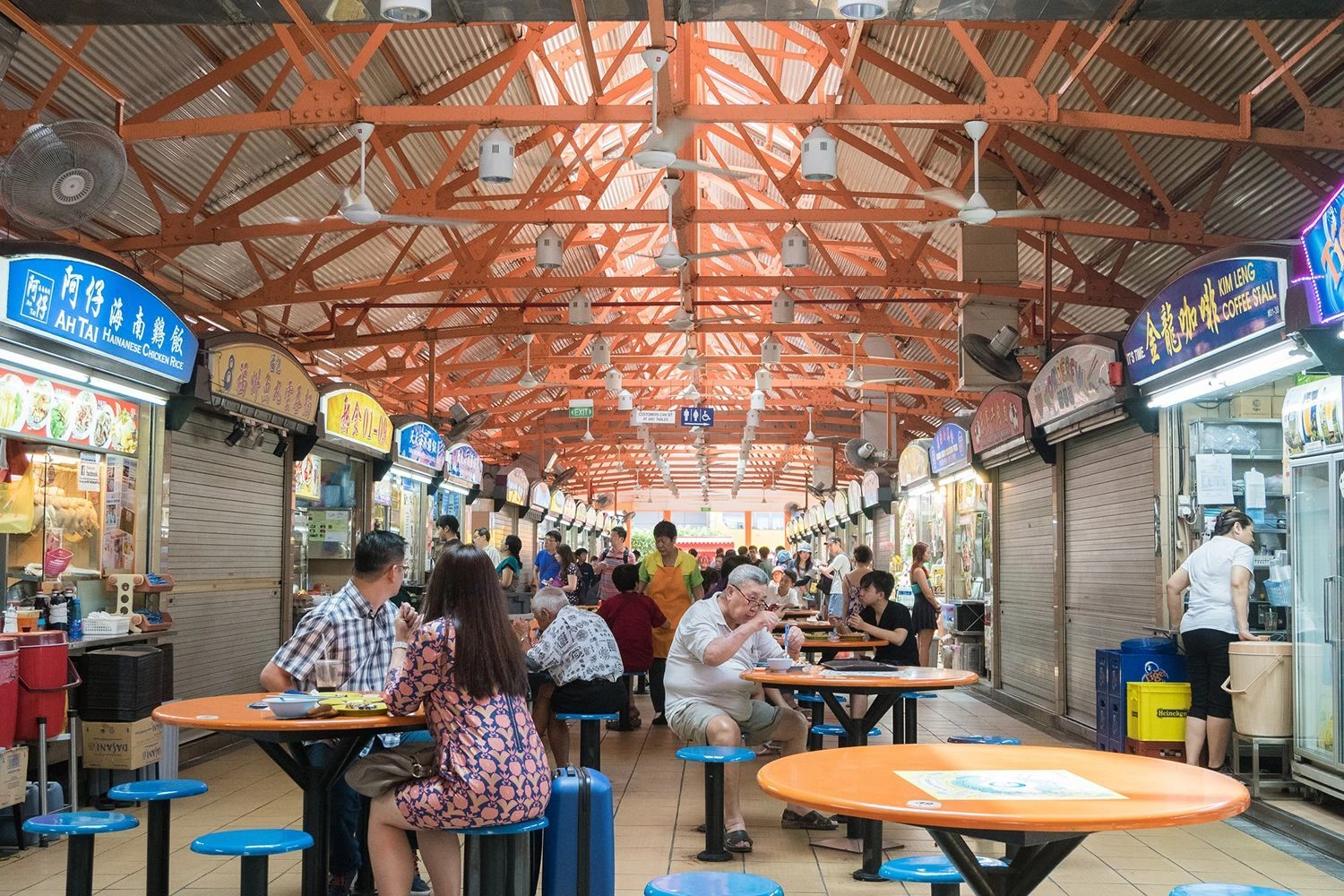
- Hawker Centers: There are 121 hawker centres in Singapore, serving delicious, affordable meals from early morning to late nights. One might argue that to understand Singapore is to experience the food that is served in the hawker centres. The nation even tried to classify hawker food as a World Heritage. While it seems impractical to live right next to a hawker centre for many reasons, one could imagine living not too far away from one, for all the times when a snack or a meal is within walking distance.
- Restaurants: Singapore is home to the most high-end cuisines in the world. When it comes to choices of Michelin-star restaurants and fine dining, Singapore does not lose out. Locals would travel distances just to dine in restaurants in neighbourhoods such as Serangoon Gardens or Railway Mall (it is not actually a mall). When it comes to food, locals are extremely discerning and would want to know that there is high quality food around the corner from them.
Parks
- Due to the rapid rise of migrant workers and expatriates in Singapore, large park spaces and green forest breathing zones have been sacrificed for housing. In its place is integrated green spaces between urban areas. Smaller, well maintained parks have been built inside housing estates and HDB towns to cater to families who crave for the outdoors. Expect to see a reduction in major parklands and properties near green zones tend to have less amenities than others but allow a more extensive outdoor lifestyle option.
Introducing the Cribs Convenience Index
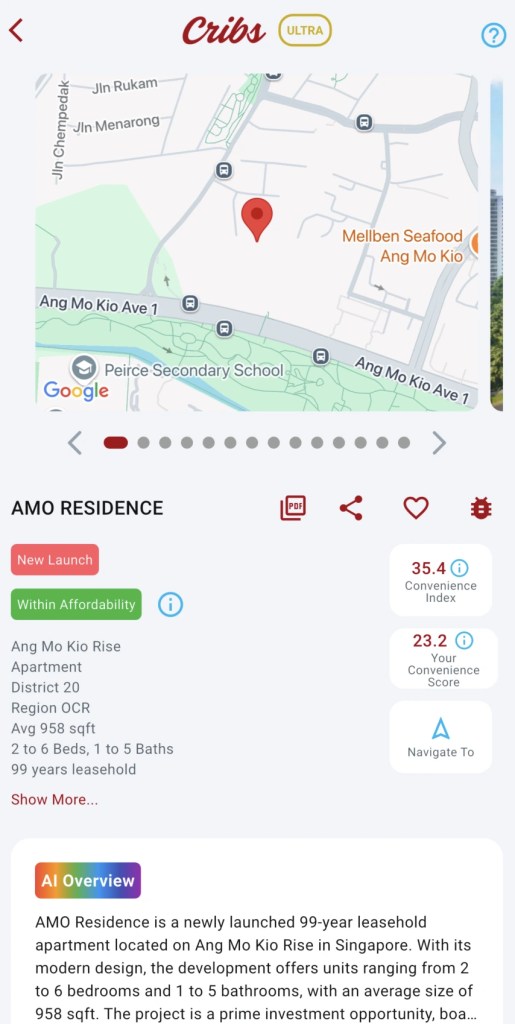
Recognizing the importance of lifestyle factors in property selection, Cribs has developed a Convenience Index that evaluates properties based on accessibility to transportation, education, healthcare, amenities, and parks. This standardized score provides buyers with a holistic view of a property’s convenience level. It is a weighted score across the above attributes and normalised to 100. Any score that is above 50 is a good score.
Personalized Convenience Scores
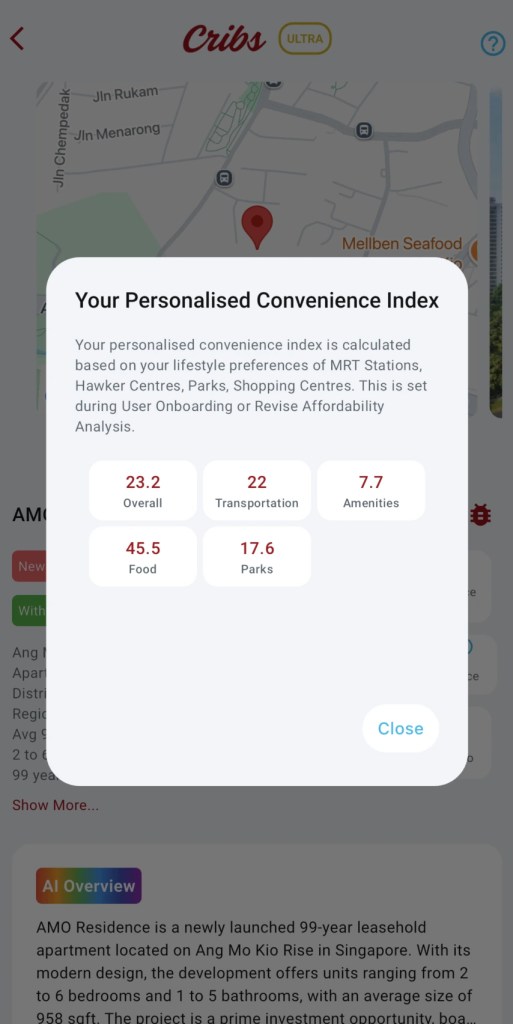
Understanding that every buyer has unique priorities, Cribs allows users to customize their Personalized Convenience Index based on five key attributes out of 16 available, for example, a buyer may choose as her top choices:
- Proximity to MRT stations
- Access to top primary schools
- Nearby shopping centers
- Availability of hawker centers
- Convenience of supermarkets

Users can select and adjust these attributes during User Onboarding, and the personalized score is calculated in real time when viewing or searching for properties. AI-driven recommendations further refine property matches based on lifestyle preferences. Additionally, the overall Convenience Index is displayed together with the personalized score for comparison. If a property’s personalized score is lower than its overall score, it indicates that certain high-scoring factors may not align with the buyer’s needs. For example, Primary Schools may not be important to a Single, and hence is not included in the personalised Convenience Score.
Final Thoughts
A property is more than just a structure—it is a home that must complement the buyer’s lifestyle and evolving needs. Choosing a location that adapts with changing preferences is essential. Cribs simplifies the decision-making process by quantifying convenience, helping buyers find properties that truly enhance their way of life.